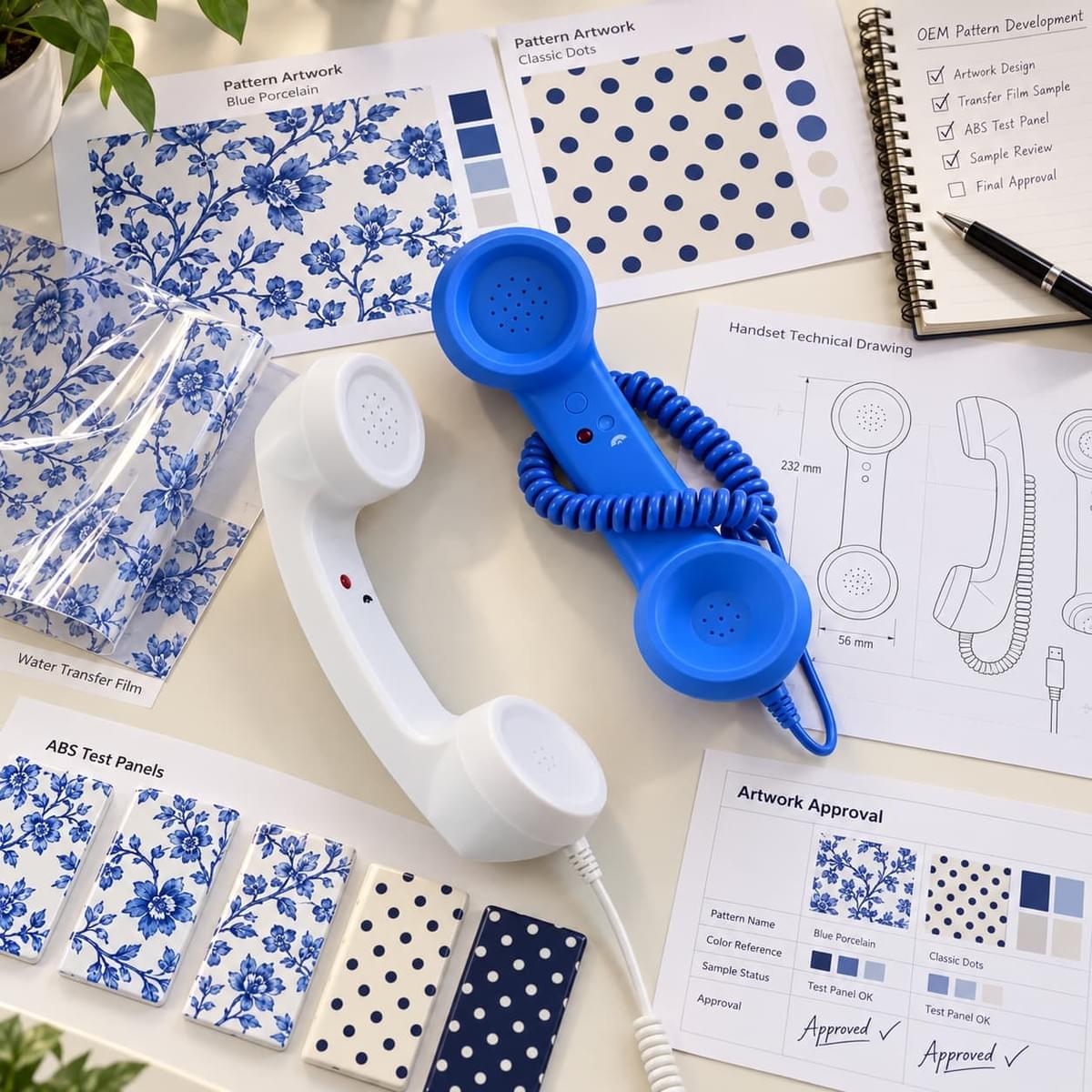
A custom pattern can transform a standard retro phone handset into a much more distinctive retail or private-label product.
Patterns can support a seasonal collection, a fashion-oriented product line, a brand collaboration or a completely different visual identity without changing the basic handset platform.
For B2B buyers, however, a pattern project involves more than sending an image file to a manufacturer.
The artwork, handset shape, printing area, decoration method, sample approval process and production quantity all affect the final result.
Pattern development should therefore be treated as part of a structured OEM and ODM handset development project.
Custom Patterns Are Different from Custom Solid Colors
A solid-color handset and a patterned handset may use the same basic product platform, but the manufacturing logic is different.
A solid molded color is created through the plastic material itself, while a printed pattern normally requires an additional surface-decoration process.
This difference can affect:
- Artwork preparation
- Sample cost
- Production setup
- MOQ
- Lead time
- Pattern placement
- Quality-control requirements
Buyers who are still deciding between a new solid shade and a printed design can first review our guide to custom colors for retro phone handsets.
Start with the Artwork and Coverage Area
Before choosing a printing process, the buyer should first define what the finished handset is supposed to look like.
A useful artwork brief should show both the design itself and where the design should appear on the handset housing.
Important questions include:
- Is the pattern repeating or directional?
- Does it cover one housing section or multiple surfaces?
- Does the design need to wrap around curved areas?
- Are exact logos, icons or text included?
- Are there areas that must remain solid color?
- Does pattern orientation matter when the handset is displayed?
These decisions should be made before sampling because they can determine which decoration process is practical.
Why Handset Shape Matters for Pattern Printing
A retro handset is not a flat printing surface.
The housing includes curved ends, recessed speaker areas, side walls, buttons and changes in surface direction.
A process that works well for a flat logo may not be suitable for a pattern that needs to follow a larger three-dimensional surface.
For this reason, pattern coverage and handset geometry should always be evaluated together before the decoration method is confirmed.
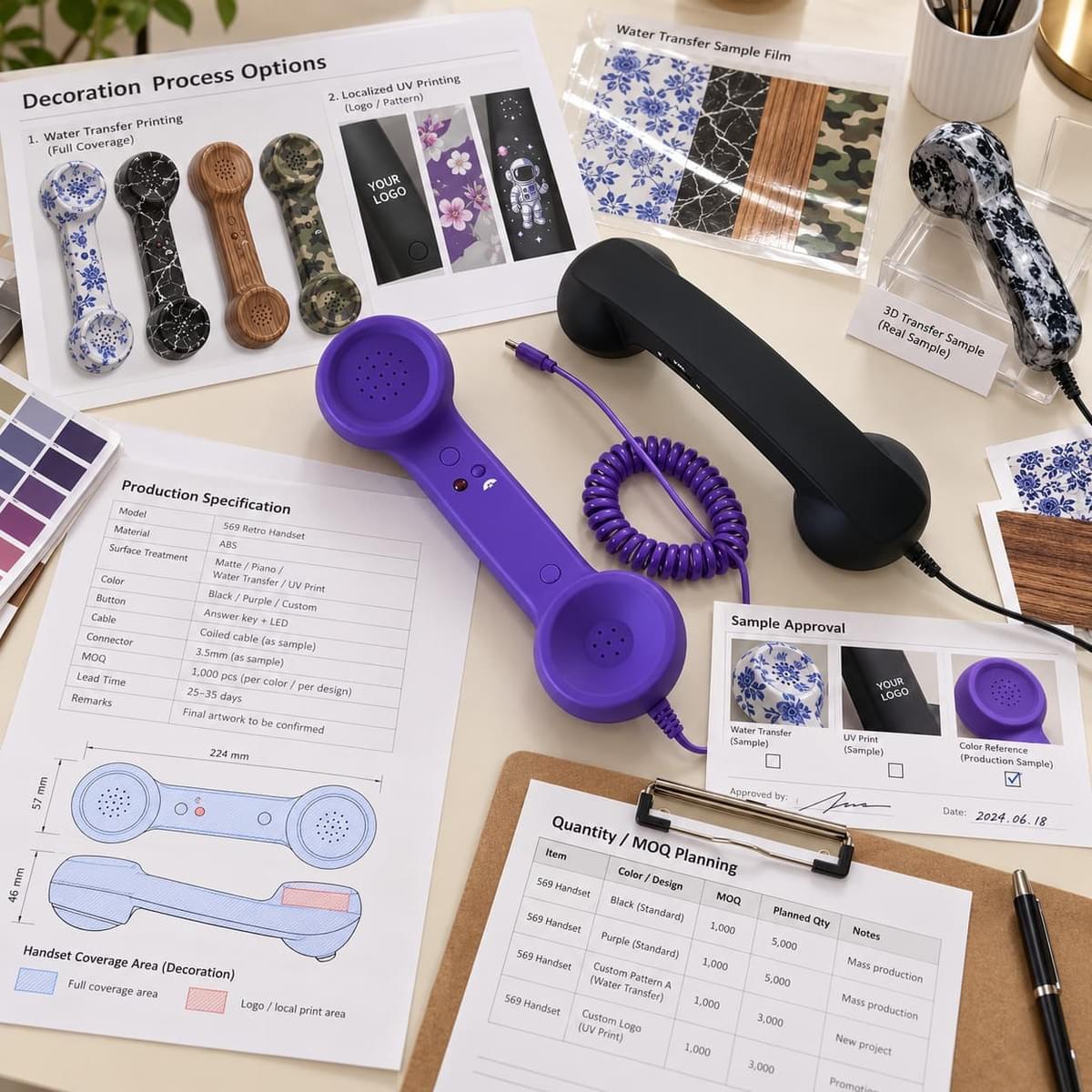
Water Transfer Printing for Decorative Patterns
Water transfer printing is one option for applying decorative graphics to three-dimensional product surfaces.
It can be useful when a design needs more visual coverage than a small printed logo or isolated graphic.
For handset projects, the actual printable area should still be confirmed during development because buttons, openings, seams and curved sections can affect pattern placement.
Repeating patterns such as abstract graphics, dots, animal-inspired prints or decorative motifs can be good candidates for evaluation through this type of process.
A physical sample is important because the buyer needs to see how the artwork changes when transferred from a flat design file onto the handset surface.
3D Vacuum Transfer for More Complex Surface Coverage
Another process that can be evaluated is 3D vacuum heat transfer.
This type of decoration can be useful when the artwork needs to conform more closely to a three-dimensional housing shape.
The final feasibility depends on the handset structure, required coverage, artwork and selected transfer material.
Buyers should therefore review a physical development sample rather than assuming that every area of the handset can be decorated identically.
UV Printing for Localized Graphics
UV printing can be considered when the project requires more localized graphics rather than a large repeating pattern.
Depending on the housing surface and design, it may be suitable for:
- Logos
- Short text
- Small illustrations
- Icons
- Selected decorative areas
A localized printing method can also be useful when the base handset color is intended to remain visible as part of the design.
Surface Color and Pattern Printing Can Be Combined
In some projects, the final appearance may involve both a base color and a separate decorative graphic.
For example, the handset may first use a specific molded or sprayed color and then receive a printed design on selected housing areas.
These are separate production decisions and should not be treated as one process.
Each additional surface treatment can affect cost, MOQ, sample requirements and production planning.
The Pattern Sample Is the Real Approval Standard
A digital artwork file is useful for development, but it is not the same as an approved production sample.
Colors can shift between a computer screen, printed film and the final plastic surface.
Pattern scale and alignment may also look different once the artwork is applied to the three-dimensional handset.
Before mass production, buyers should therefore confirm:
- Pattern scale
- Pattern position
- Color appearance
- Coverage area
- Orientation
- Surface quality
- Overall visual balance
Once approved, the physical sample provides a clearer production reference than the artwork file alone.
Why Pattern Projects Usually Need Higher MOQs
Pattern customization usually involves additional preparation beyond producing a standard solid-color handset.
Depending on the process, production may require custom films, artwork setup, printing fixtures, transfer preparation, trial pieces and additional quality checks.
These setup steps make very small production runs less efficient.
The MOQ therefore depends on the handset model, decoration method, artwork coverage and production requirements rather than on the image file alone.
Buyers preparing a first OEM order can also review our wholesale retro phone handset buying guide for broader order-planning considerations.
What Artwork Should a Buyer Prepare?
The clearer the source artwork, the easier it is to evaluate the correct production process.
Useful project information includes:
- High-resolution or vector artwork where available
- Pattern repeat information
- Color references
- Desired handset model
- Required print coverage
- Target quantity
- Reference photographs or visual mockups
- Target launch schedule
These details allow the manufacturer to evaluate the artwork as a production project rather than simply as a visual concept.
Model 569 as a Platform for Pattern Development
The 569 USB Type-C handset family provides an existing product platform that buyers can use as a starting point for OEM development.
A buyer can begin with the existing handset structure and then evaluate custom color, pattern artwork, packaging and other private-label requirements according to the project.
Starting with an established product platform can reduce development complexity compared with creating an entirely new handset structure.
Choosing the Right Pattern Process
There is no single printing method that is best for every custom pattern handset.
The right production route depends on:
artwork + coverage area + handset geometry + surface finish + quantity + target appearance.
A large repeating pattern may require a different process from a small logo or localized graphic.
This is why process selection should happen after the manufacturer reviews the actual artwork and intended print area.
Sample First, Then Confirm Mass Production
For pattern projects, the sample stage is one of the most important parts of the development process.
A practical workflow is:
artwork → process evaluation → test sample → pattern adjustment → buyer approval → mass production.
This approach allows both the buyer and manufacturer to identify visual or production issues before a larger order begins.
Final Thoughts
Pattern customization gives B2B buyers another way to differentiate a retro phone handset beyond standard solid colors.
The key is to treat the pattern as a manufacturing project rather than simply a graphic design.
Artwork quality, print coverage, handset geometry, production method, MOQ and sample approval all need to work together.
Buyers planning a private-label project can review our broader OEM and ODM retro phone handset guide or contact NEW POWER TECH to discuss artwork, samples and production requirements.
Frequently Asked Questions
Can a retro phone handset have a custom printed pattern?
Yes. Pattern customization can be evaluated using different surface-decoration processes depending on the handset model, artwork, required coverage and production quantity.
What is the difference between a custom color and a custom pattern?
A custom solid color changes the base appearance of the handset housing, while a custom pattern normally requires an additional printing or transfer process on the product surface.
Can water transfer printing be used on retro handsets?
Water transfer printing can be evaluated for decorative patterns on three-dimensional handset housing areas. Exact coverage and feasibility should be confirmed through sampling.
When is UV printing more suitable?
UV printing can be useful for more localized graphics such as logos, text, icons or selected decorative areas, depending on the surface and product design.
Why do custom pattern projects require samples?
A physical sample shows how the flat artwork actually appears on the handset, including pattern scale, orientation, color, coverage and surface quality.
Does every pattern have the same MOQ?
No. MOQ depends on the printing process, artwork, coverage area, handset model and production setup required for the project.
Can a custom base color and printed pattern be combined?
Yes. A project can combine a selected base color with a separate decorative process, but the additional production steps, sampling requirements and MOQ should be evaluated together.