
Sourcing a retro phone handset from China can look simple at first: find a product, request a price and place an order.
For a professional B2B buyer, however, the real sourcing process involves much more than comparing unit prices.
The handset model, connection interface, electronics, cable structure, device compatibility, customization requirements, packaging and production consistency all need to be evaluated before a supplier is selected.
Buyers searching for a retro phone handset supplier in China should therefore focus on whether the supplier can clearly explain and support the complete product rather than simply provide a quotation.
If you are still comparing potential suppliers, our guide to choosing a reliable retro phone handset manufacturer provides a useful starting point.
Start by Defining the Product You Actually Need
Before contacting a supplier, the buyer should define the basic product requirements as clearly as possible.
Important questions include:
- Which handset model or shape is required?
- Does the target market need USB Type-C, 3.5mm or Bluetooth?
- Which devices will customers use with the handset?
- Which colors are required?
- Is the project standard wholesale or private label?
- Is custom packaging required?
- What is the expected order quantity?
A clear specification allows suppliers to quote the correct product rather than making assumptions based only on a photograph.
Do Not Evaluate a Supplier by Price Alone
Price is important, but the lowest quotation is not automatically the lowest sourcing cost.
A buyer should also evaluate whether the supplier can provide:
- Clear product specifications
- Consistent model identification
- Interface and cable information
- Sample support
- Customization options
- Packaging information
- Production lead-time guidance
- Responsive communication
When these details are unclear before ordering, they often become larger problems after production has already started.
Manufacturer, Supplier or Trading Company?
Overseas buyers may encounter manufacturers, sourcing companies and trading companies when searching for retro phone handsets in China.
The important question is not simply which business label appears on a website.
What matters is whether the supplier understands the product deeply enough to support specifications, quality control, customization and repeat production.
For OEM or private-label projects, direct access to product development and production knowledge becomes especially valuable because the buyer may need to discuss colors, patterns, logo placement, packaging and technical details.
A supplier should be able to explain what can be customized, what requires a sample, and which requirements may change MOQ or production lead time.
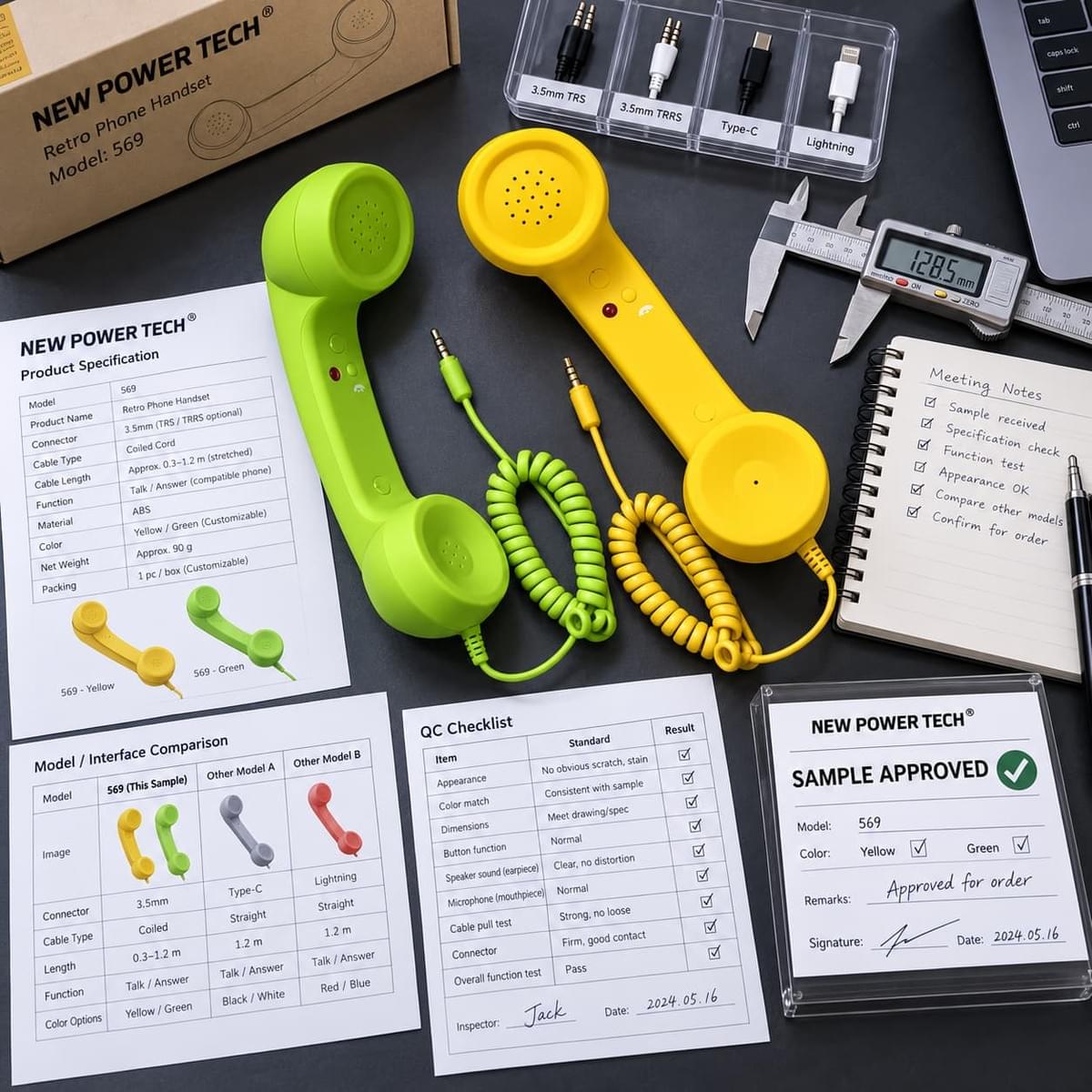
Always Test a Sample Before Bulk Production
Product photographs cannot fully confirm how a handset performs with the buyer's intended devices.
Before placing a larger wholesale order, buyers should test a representative sample whenever practical.
Sample evaluation can include:
- Handset appearance and finish
- Speaker and microphone performance
- Button operation
- Cable construction
- Connector type
- Device compatibility
- Packaging quality
For USB Type-C products in particular, buyers should not assume that the physical connector alone guarantees the same behavior across every host device.
Our guide to USB-C vs 3.5mm retro handsets explains why the intended device environment should be considered before selecting an interface.
Ask for Clear Product Specifications
A reliable wholesale program depends on both parties identifying the product in the same way.
The supplier should be able to confirm key specifications such as:
- Product model
- Connection interface
- Available colors
- Cable design
- Button functions
- Target device category
- Standard packaging
Clear specifications are particularly important when the buyer plans repeat orders.
A product described only as a “retro handset” is not specific enough when several molds, interfaces and versions are available.
Evaluate Customization Before You Finalize the Supplier
Many B2B sourcing projects begin with a standard product but later expand into a more differentiated retail program.
Buyers may eventually require:
- Custom colors
- Printed patterns
- Logo application
- Private-label packaging
- User manuals
- Product labels
If customization is likely to become important, it is better to evaluate this capability during supplier selection rather than after a large standard order has already been placed.
NEW POWER TECH supports OEM and ODM retro phone handset projects based on project requirements.
Understand MOQ as Part of the Production Process
Buyers often ask for one MOQ number, but the minimum quantity can change depending on what is being ordered.
An existing product in a standard color may have a different requirement from:
- A custom molded color
- A printed pattern
- Logo application
- Custom retail packaging
- A newly developed product configuration
Customization introduces additional setup work, materials and production steps.
Buyers should therefore discuss MOQ together with the exact customization requirement rather than assuming one MOQ applies to every project.
Compare Suppliers Using the Same Requirements
Supplier comparisons are more meaningful when every supplier receives the same brief.
If one supplier quotes a standard product while another supplier includes a custom color, branded box or different connector, the prices are not directly comparable.
A structured RFQ should include:
- Model or reference product
- Interface
- Color
- Quantity
- Packaging requirement
- Customization requirement
- Destination market
This makes it easier to compare the real commercial offer rather than comparing isolated unit prices.
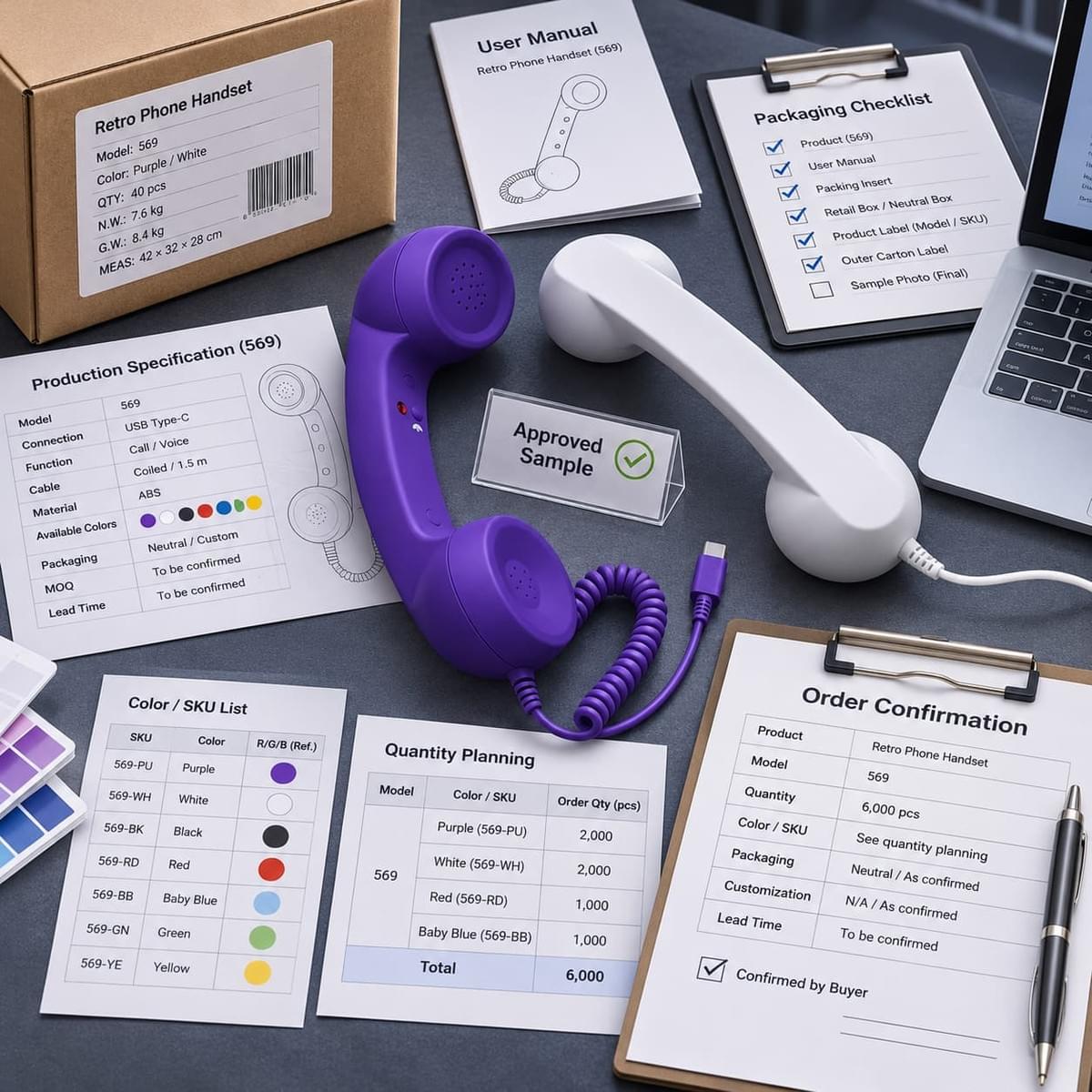
Confirm the Production Specification Before Mass Production
Once the sample is approved, the next step is to convert that approved product into a clear production specification.
The order should confirm details such as:
- Exact product model
- Interface
- Color and SKU
- Quantity
- Logo or artwork
- Packaging
- Labels and manuals
An approved sample and written specification give both buyer and supplier a clearer reference for production.
Think About Repeat Orders from the Beginning
A good sourcing relationship should not depend on recreating the product specification from the beginning every time a buyer needs stock.
Clear model numbers, SKU organization, color names and approved specifications make repeat orders easier to manage.
This is particularly important for wholesalers and retailers carrying several colors or interfaces.
Buyers planning an initial commercial order can also review our wholesale retro phone handset buying guide.
Why Source Retro Phone Handsets from Shenzhen?
For buyers sourcing phone accessories from China, working with a supplier that understands product development, electronics, customization and export-oriented B2B requirements can simplify communication across the project.
NEW POWER TECH focuses on retro phone handsets for wholesale, OEM and ODM projects, including wired and wireless product platforms and customization based on buyer requirements.
The goal is not simply to provide a handset, but to help buyers define the right product configuration before production begins.
A Practical China Sourcing Workflow
A structured sourcing process can be summarized as:
define requirements → shortlist suppliers → compare specifications → obtain sample → test sample → confirm customization → approve production specification → place bulk order.
Following this sequence reduces the risk of making a purchasing decision based only on photographs or price.
Final Thoughts
Finding a retro phone handset supplier in China is only the first step.
The more important task is finding a supplier that can consistently support the product your market actually requires.
Buyers should evaluate specifications, samples, interfaces, customization capability, production planning and repeat-order support together.
A reliable sourcing decision is therefore based on:
product understanding + sample verification + clear specifications + production capability + communication.
Contact NEW POWER TECH to discuss retro phone handset sourcing from China, wholesale orders, product samples or OEM/ODM requirements.
Frequently Asked Questions
What should I ask a retro phone handset supplier in China?
Ask about the exact model, interface, available colors, sample options, MOQ, packaging, customization, production lead time and supported device categories.
Should I order a sample before a wholesale order?
Sample testing is recommended because it allows the buyer to evaluate the physical product, audio functions, controls, connector and compatibility with representative devices before bulk production.
Can Chinese retro handset manufacturers support private label?
Private-label options may include logo application, product colors, printed patterns, packaging, manuals and labels depending on the model, process and order quantity.
Is USB Type-C always compatible with every smartphone?
No. The physical connector alone does not guarantee universal audio compatibility. The handset electronics and host device must support the required audio implementation.
Can I order different colors in one wholesale program?
Multi-color assortments can be discussed according to the selected model, available colors, quantity and production requirements.
What information should I send when requesting a quotation?
Provide the product model or reference, interface, desired colors, quantity, destination market, packaging requirements and any logo, private-label or OEM customization needs.